
Home / News and Updates
Article by Mary Jane F. Nacpil
In XXX280727 vs. People of the Philippines (G.R. No. 280727, February 4, 2026), the Supreme Court ruled that: Sexual violence devastates equally, regardless of gender. However, people may vary in their reactions and the way they cope with distressing situations. Thus, the fact that a person’s reaction to an incident is different from what is deemed “standard,” does not diminish the credibility of their claims.
In this case, while the child was asleep, the woman woke him up, and made him lie on her bed, and ordered him to remove his clothes involving sexual intercourse with him. This occurred while the child was visiting his relatives with his father’s side.
At first of because of curiosity, the child did not protest of what was happening. But after the incident, the child felt ashamed of himself and deemed ending his own life.
The child was diagnosed with post-traumatic stress disorder resulting from sexual abuse this was found in his psychological debriefing and supportive psychotherapy.
Both the Regional Trial Court and the Court of Appeals found the woman guilty of acts of lasciviousness in relation to Section 5(b) of the Republic Act No. (RA) 7610 or the Special Protection of Children Against Abuse, Exploitation, and Discrimination Act.
The woman argued that the child had consented to the sexual act. But the Supreme Court disagreed with it. Because at the time of the incident year 2018, the child was only 11 years old, wherein he was deemed legally incapable of giving consent. Thus:
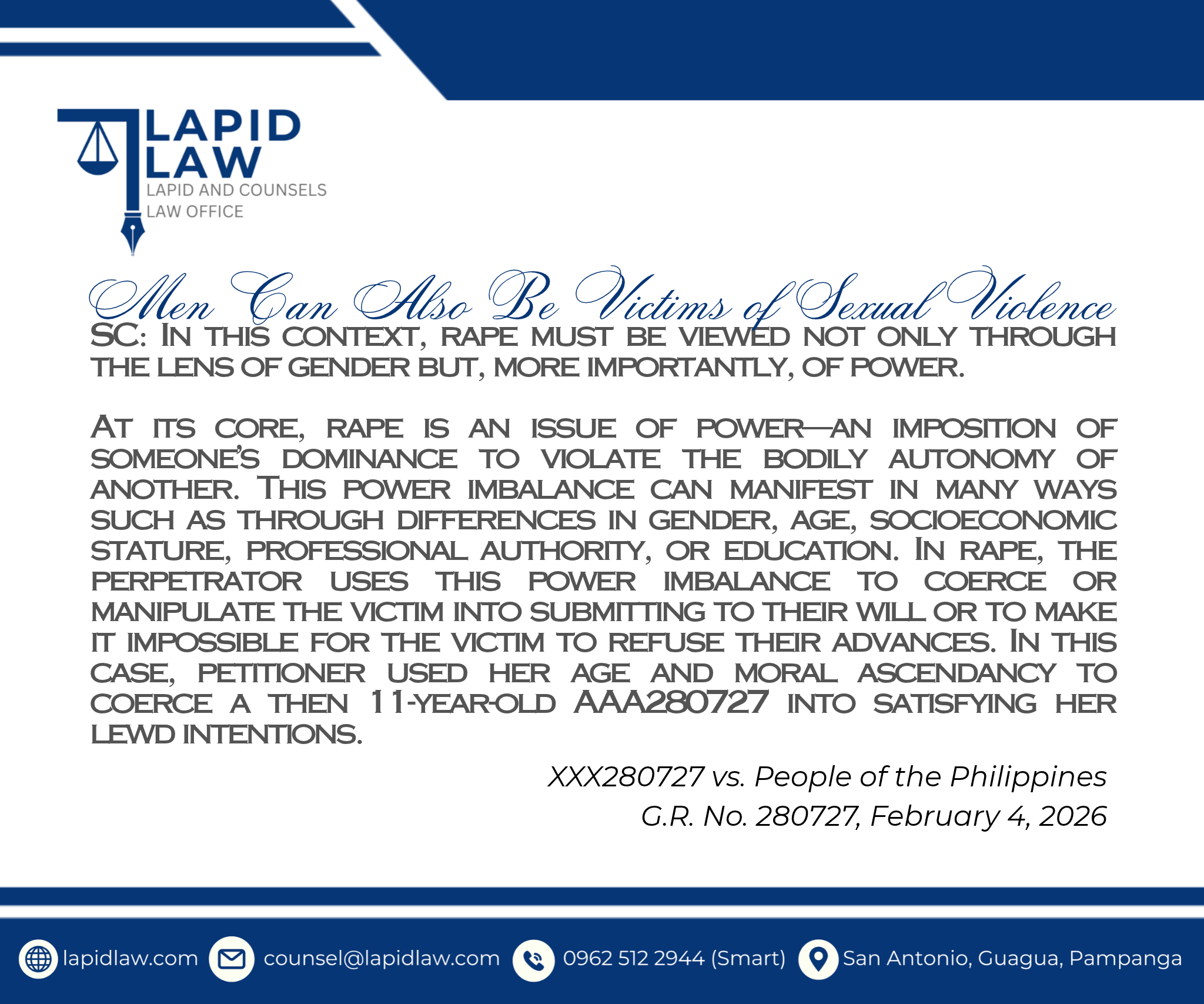
In this context, rape must be viewed not only through the lens of gender but, more importantly, of power.
At its core, rape is an issue of power—an imposition of someone’s dominance to violate the bodily autonomy of another. This power imbalance can manifest in many ways such as through differences in gender, age, socioeconomic stature, professional authority, or education. In rape, the perpetrator uses this power imbalance to coerce or manipulate the victim into submitting to their will or to make it impossible for the victim to refuse their advances. In this case, petitioner used her age and moral ascendancy to coerce a then 11-year-old AAA280727 into satisfying her lewd intentions.
In several jurisdictions, gender-neutral reforms on rape laws have been adopted to protect a person’s sexual autonomy from the harm brought by non-consensual penetrative sex acts. These reforms focus on a consent-based approach on rape and are grounded on the principle that “all persons should be protected equally from harm of like degree.” The acknowledgment and proper labeling of such abuse aim to “break down societal notions of denial and assist male and female victims in seeking support and legal redress.”
The SC explained that RA 7610 does not apply when a minor is entirely unaware and unable to give legal consent. It only applies when a minor appears to consent to sexual activity due to the influence of an adult, as in this case.
The Supreme Court acclaimed that the woman was charged with statutory acts of lasciviousness because her act did not fall within the legal definition of rape under Article 266-A of the Revised Penal Code, at the time of the offense.
Nonetheless, RA 11648, enacted in 2022, broadened the definition of rape, stating that it may be perpetrated by any person who has sensual knowledge of another person under the circumstances stated by law.
Despite statutory updates allowing women to be recognized as perpetrators of rape, the Supreme Court noted that judicial opinions often still treat rape strictly as a crime committed by men against women. The Court traced this persistent bias to ancient, patriarchal laws that viewed rape as a property crime against a woman’s father or husband rather than a violation of her bodily autonomy. Maintaining these outdated views excludes male victims from equal legal protection, despite their suffering the exact same trauma. Furthermore, failing to acknowledge that men can be raped creates societal stigma that prevents male survivors from recognizing their abuse and seeking justice. Ultimately, the SC affirmed the woman’s conviction, sentencing her to nine to 16 years in prison and ordering PHP 250,000 in damages.
Legal Disclaimer:
The content on this website is for general informational purposes only and does not constitute legal advice. Lapid and Counsels Law Office (Lapid Law) makes no representations or warranties regarding the accuracy or completeness of the information provided. Accessing this site does not create an attorney-client relationship. For legal advice specific to your situation, please contact a qualified attorney directly. Do not send confidential information via email or this website until a formal attorney-client relationship has been established.
© Copyright. Lapid and Counsels Law Office 2025. All Rights Reserved.