Home / News and Updates
Article by Ms. Angelica S. Garcia
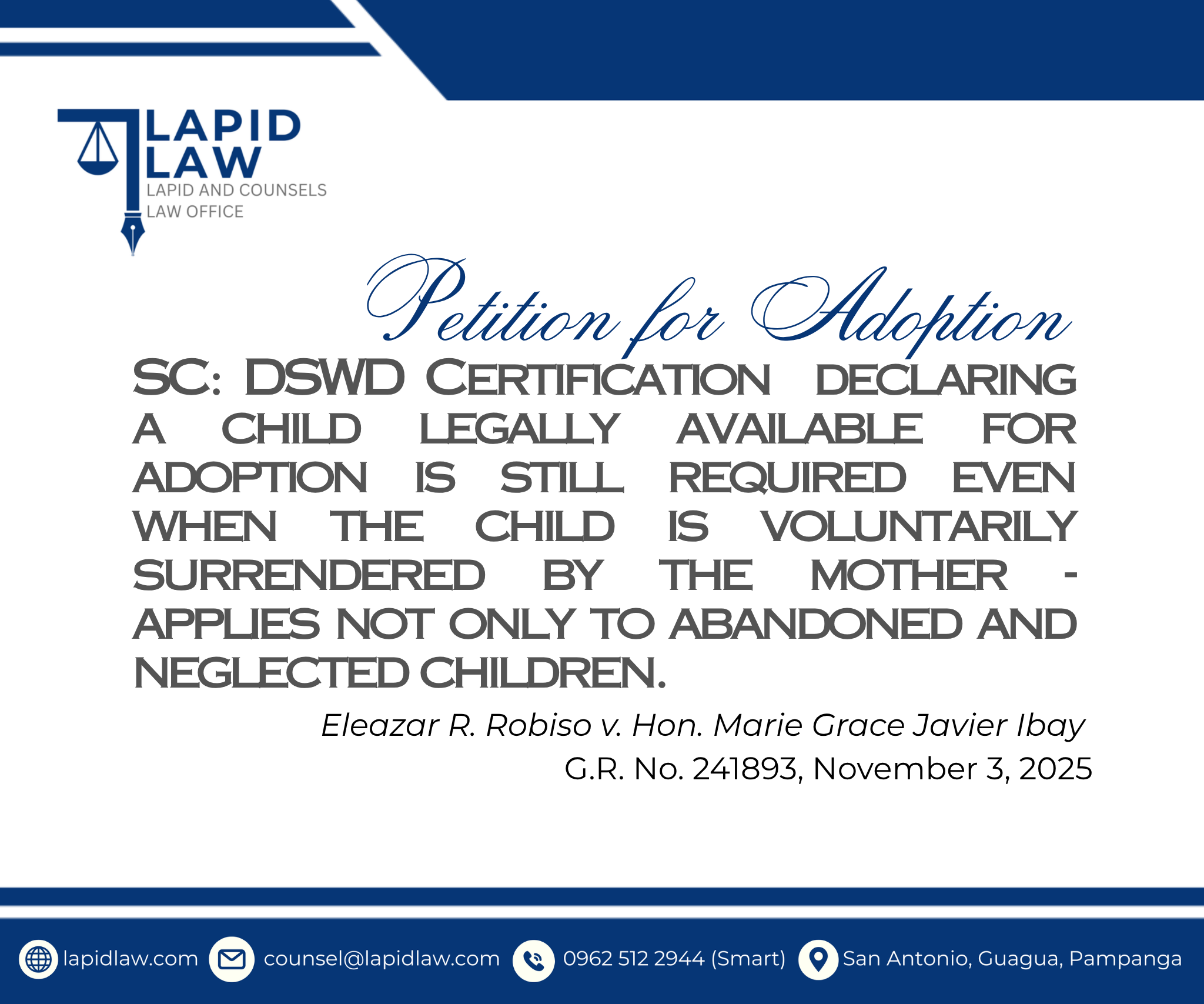
In Eleazar R. Robiso v. Hon. Marie Grace Javier Ibay (G.R. No. 241893, November 3, 2025), the Supreme Court ruled that a certification declaring a child legally available for adoption is still required even when the child is voluntarily surrendered by the mother.
The Court upheld the dismissal of the adoption petition filed by Eleazar Robiso after finding that he failed to secure the required certification from the Department of Social Welfare and Development (DSWD). The ruling clarified that under Republic Act No. 9523, the certification requirement applies not only to abandoned and neglected children, but also to surrendered children.
The ruling stressed that adoption laws must be strictly followed to ensure the protection and welfare of children. According to the Court, compliance with legal requirements cannot be disregarded even if the prospective adopter genuinely wishes to provide the child with a stable and loving home.
In this case, the biological mother left her baby in the care of Robiso and his parents shortly after giving birth. A year later, Robiso filed a petition for adoption before the Regional Trial Court. To support his petition, he submitted an Affidavit of Consent to Adoption and Grant of Custody of Child executed by the mother, where she stated that she could no longer financially support the child and was voluntarily entrusting parental authority to him.
The Regional Trial Court dismissed the petition after ruling that the child was considered a surrendered or voluntarily committed child, which required a DSWD certification declaring the child legally available for adoption. The Court of Appeals later affirmed the dismissal.
Before the Supreme Court, Robiso argued that the certification requirement applied only to abandoned, neglected, or voluntarily committed children and not to surrendered children. However, the Court disagreed and explained that the implementing rules of Republic Act No. 9523 treat surrendered children in the same manner as voluntarily committed children.
The Court also explained that Presidential Decree No. 603, or the Child and Youth Welfare Code, considers a child surrendered to another person as voluntarily committed. As a result, prospective adopters must first secure the necessary DSWD certification before filing an adoption petition.
The Court further clarified that the certification requirement does not apply in certain cases where there is an existing relationship between the adopter and adoptee, such as adoption by a biological parent of an illegitimate child, a step-parent, or a relative within the fourth degree.
The Court concluded that since the child in this case was properly considered a surrendered child, the dismissal of the adoption petition was correct due to the absence of the required DSWD certification. However, it clarified that Robiso may still pursue the appropriate remedy under Republic Act No. 11642, or the Domestic Administrative Adoption and Alternative Child Care Act.
Legal Disclaimer:
The content on this website is for general informational purposes only and does not constitute legal advice. Lapid and Counsels Law Office (Lapid Law) makes no representations or warranties regarding the accuracy or completeness of the information provided. Accessing this site does not create an attorney-client relationship. For legal advice specific to your situation, please contact a qualified attorney directly. Do not send confidential information via email or this website until a formal attorney-client relationship has been established.
© Copyright. Lapid and Counsels Law Office 2025. All Rights Reserved.