
Home / News and Updates
Article by Angelica S. Garcia
The Supreme Court, in Benito A. Somo vs. People (G.R. No. 256102, August 26, 2026), has ruled that simulation of birth is a crime mala in se, which requires proof of criminal intent before a person may be convicted. It also clarified that a person cannot be separately convicted under Article 347 of the Revised Penal Code (RPC) and Section 21(b) of Republic Act No. 8552 for the same act of falsely registering a child’s birth. Thus:
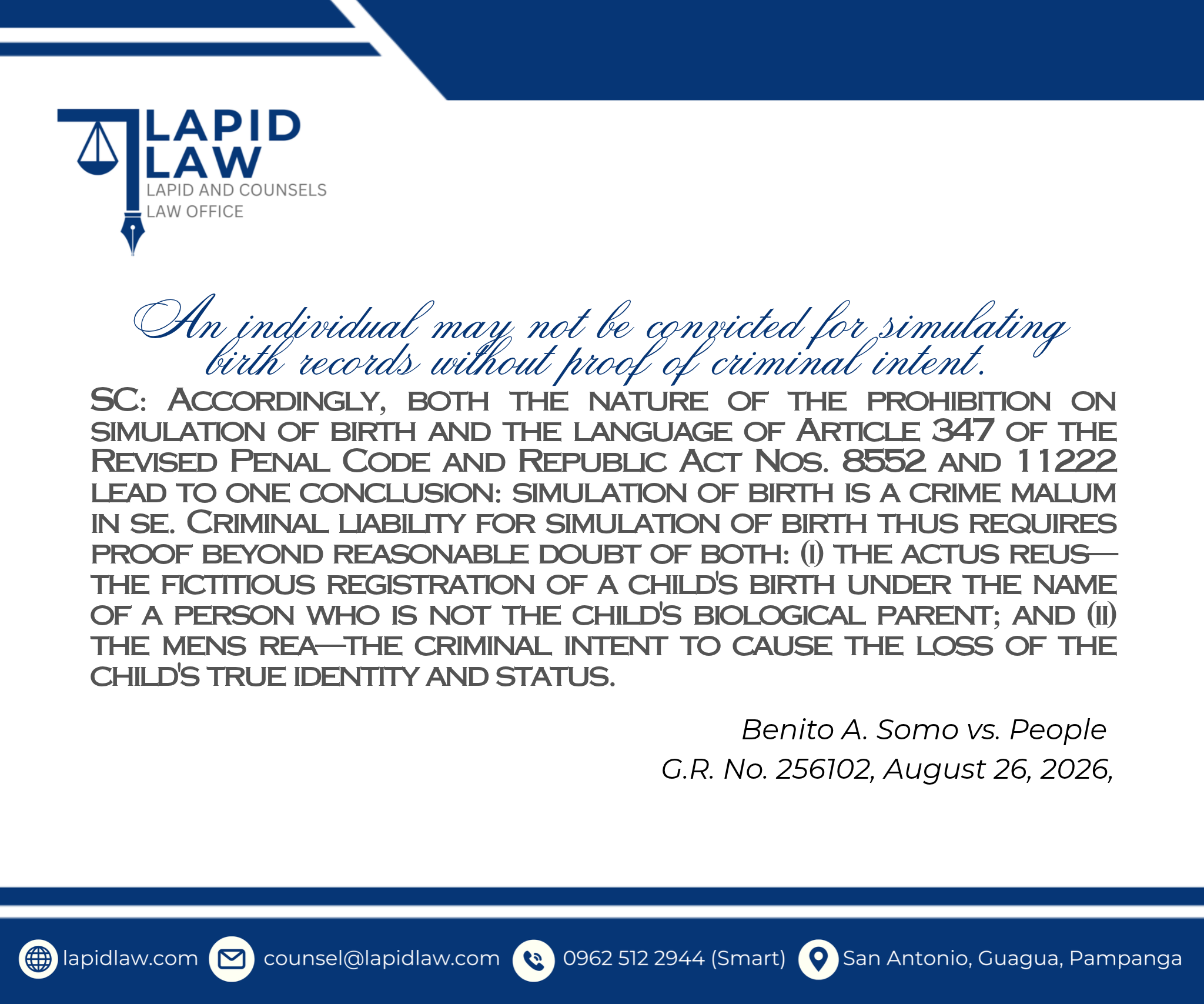
“Accordingly, both the nature of the prohibition on simulation of birth and the language of Article 347 of the Revised Penal Code and Republic Act Nos. 8552 and 11222 lead to one conclusion: simulation of birth is a crime malum in se. Criminal liability for simulation of birth thus requires proof beyond reasonable doubt of both: (i) the actus reus—the fictitious registration of a child’s birth under the name of a person who is not the child’s biological parent; and (ii) the mens rea—the criminal intent to cause the loss of the child’s true identity and status.”
In a Decision drafted by Associate Justice Alfredo Benjamin S. Caguioa, the Supreme Court En Banc acquitted Benito A. Somo of simulation of birth after finding that the prosecution failed to establish the required criminal intent.
The case originated from Somo’s registration of a second birth certificate for his grandson, identifying himself and his wife as the child’s parents. The child’s biological father, who used two different names, had earlier authorized the arrangement in writing to prevent problems over his son’s identity. The second birth certificate was used for the child’s school enrollment and passport.
The Regional Trial Court and the Court of Appeals found Somo guilty of two separate crimes under the RPC and RA 8552. The Supreme Court, however, reversed their rulings.
The Court first addressed whether Somo could be convicted separately under the two laws. It explained that Article 347 of the RPC penalizes simulation of birth but does not define the offense or describe how it is committed. RA 8552 later clarified the offense by defining simulation of birth as tampering with a child’s birth record in the civil registry.
The Supreme Court ruled that RA 8552 did not create a separate crime but merely clarified an offense already punishable under the RPC. Since both charges against Somo arose from the same birth certificate, false registration, and claim of parentage, he could not be prosecuted or punished twice for the same offense.
The Court also discussed the distinction between crimes mala in se and mala prohibita. It clarified that the law punishing an act does not determine its classification. Instead, crimes are generally considered mala in se because criminal law punishes the evil mind attending the act.
The Court explained that the legislature may classify crimes as mala prohibita depending on the purpose of the statute and the language it uses. When a crime is classified as mala prohibita, the punishment imposed must be minimal, considering that the offense may be committed even without criminal intent.
Applying these principles, the Supreme Court ruled that simulation of birth is a crime mala in se because it is inherently wrong and requires proof of criminal intent. The Court explained that the act affects a child’s legal identity, family relationships, and constitutional rights, including the sanctity of family life and the parents’ primary right and duty to raise their children.
Nevertheless, the Court emphasized that the mere registration of a false birth certificate is not enough to establish criminal liability. The prosecution must also prove that the accused intended to cause the child to lose their true identity and status.
In Somo’s case, although the false registration was established, the prosecution failed to prove criminal intent. The Court noted that the child’s original birth certificate, identifying his biological parents, remained intact. There was also no showing that Somo benefited from the registration or that anyone was harmed.
Moreover, the child’s biological father had authorized the arrangement, while Somo later filed a petition for adoption and correction of the birth record. The Court found that Somo did not intend to defraud the State or conceal his grandson’s origins. After the parents separated, he assumed the parental role to provide his grandson with stability, legal documentation, and access to essential services.
The Supreme Court stressed that simulation of birth may be rooted in survival and compassion rather than criminal design. It recognized that some people resort to such arrangements because of a lack of knowledge of legal procedures, difficulties with bureaucratic systems, or the need to access government services. The Court emphasized that the criminal justice system should not be weapon Applying these principles, the Supreme Court clarified that simulation of birth is a crime classified as mala in se, meaning an act that is inherently wrong and requires proof of criminal intent.
The Court ruled that simulating birth is inherently wrong because it affects a child’s legal identity, family relationships, and constitutional rights, including the sanctity of family life and the parents’ primary right and duty to raise their children.
However, merely registering a false birth certificate is not enough to establish criminal liability. The prosecution must also prove that the accused intended to cause the child to lose their true identity and status.
In this case, although the false registration was established, the prosecution failed to prove criminal intent. The Court noted that the child’s original birth certificate, naming his biological parents, remained intact. The second certificate was used for the child’s school enrollment and travel documents, and there was no showing that Somo benefited from the registration or that anyone was harmed.
The child’s biological father had also authorized the arrangement, while Somo later filed a petition for adoption and correction of the birth record.
The Supreme Court found that Somo did not intend to defraud the State or conceal his grandson’s origins. After the parents separated, he assumed the parental role to provide his grandson with stability, legal documentation, and access to essential services.
Legal Disclaimer:
The content on this website is for general informational purposes only and does not constitute legal advice. Lapid and Counsels Law Office (Lapid Law) makes no representations or warranties regarding the accuracy or completeness of the information provided. Accessing this site does not create an attorney-client relationship. For legal advice specific to your situation, please contact a qualified attorney directly. Do not send confidential information via email or this website until a formal attorney-client relationship has been established.
© Copyright. Lapid and Counsels Law Office 2025. All Rights Reserved.