Home / News and Updates
Article by Ms. Mary Jane F. Nacpil
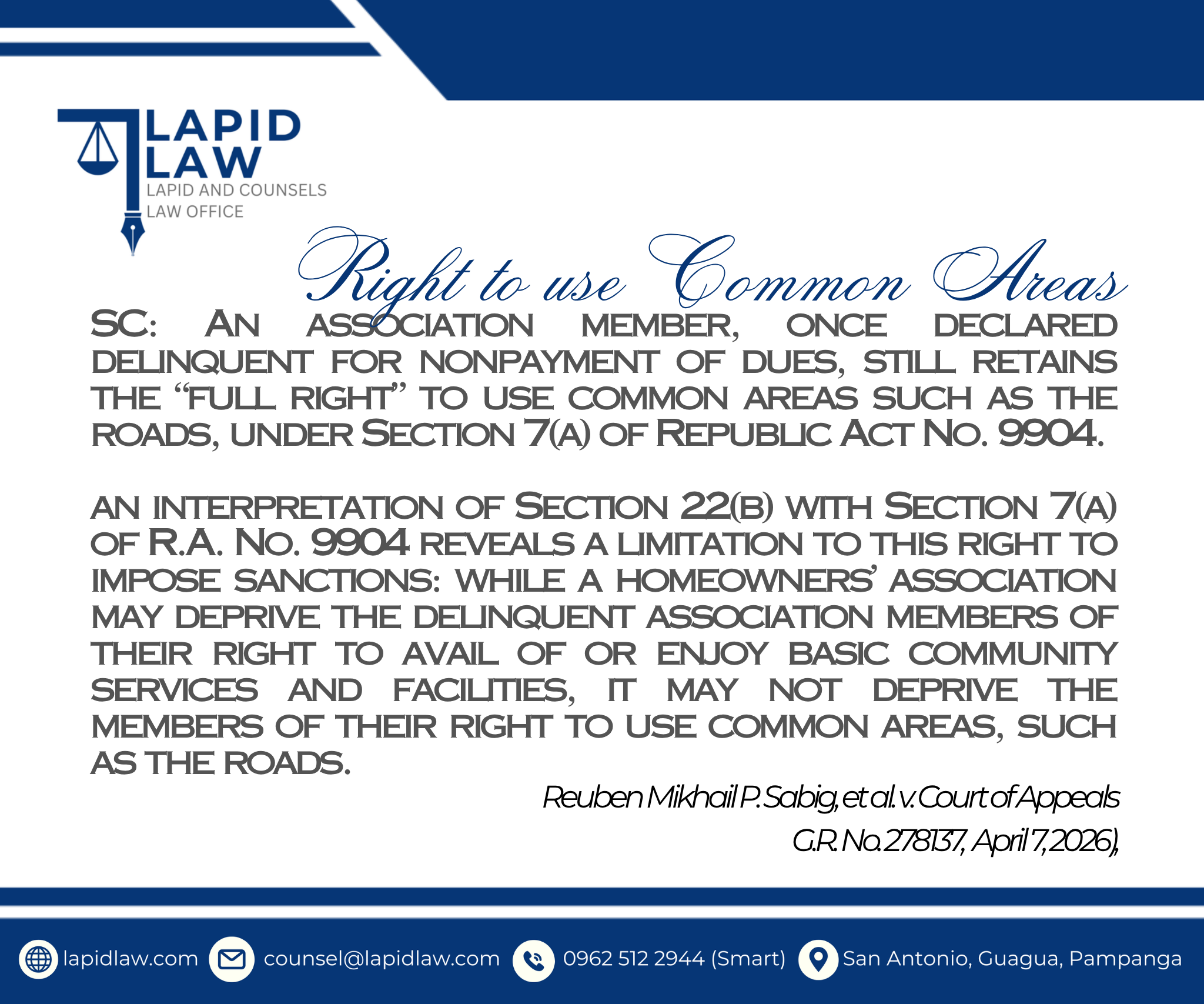
The Supreme Court, in Reuben Mikhail P. Sabig, et al. v. Court of Appeals (G.R. No. 278137, April 7, 2026), discussed that an interpretation of Section 22(b) with Section 7(a) of Republic Act No. 9904 reveals a limitation to this right to impose sanctions: while a homeowners’ association may deprive the delinquent association members of their right to avail of or enjoy basic community services and facilities, it may not deprive the members of their right to use common areas, such as the roads.
The Supreme Court has clarified the extent of a homeowners’ association’s authority to sanction members who fail to pay association dues. While Republic Act No. 9904, or the Magna Carta for Homeowners and Homeowners’ Associations, authorizes homeowners’ associations (HOAs) to impose sanctions on delinquent members, such authority is not without limits. Specifically, an HOA cannot deprive homeowners of their statutory right to use common areas, including subdivision roads.
The case arose after the La Costa Brava Homeowners’ Association declared spouses Linley and Juvy Retirado delinquent for their failure to pay association dues from 2016 to 2021. As a consequence, the HOA imposed several sanctions, including restrictions on deliveries, transportation services, guest access, garbage collection, and property maintenance.
The Human Settlements Adjudication Commission (HSAC) ruled in favor of the spouses, finding that the HOA violated their rights under Republic Act No. 9904. It likewise permanently disqualified the responsible HOA officers from holding office. The Supreme Court affirmed the HSAC’s ruling.
In explaining its decision, the Court first recognized that the law grants homeowners’ associations the authority to impose sanctions upon delinquent members:
“Under Sections 9 and 10(l) of Republic Act No. 9904, a homeowners’ association has the right to impose sanctions upon members that are declared delinquent in accordance with its bylaws.“
However, the Court immediately emphasized that this authority is not absolute:
“The right to impose sanctions is not absolute.“
Construing Sections 7(a) and 22(b) of Republic Act No. 9904 together, the Court held:
“An interpretation of Section 22(b) with Section 7(a) of Republic Act No. 9904 reveals a limitation to this right to impose sanctions: while a homeowners’ association may deprive the delinquent association members of their right to avail of or enjoy basic community services and facilities, it may not deprive the members of their right to use common areas, such as the roads.“
The Court explained that Section 7(a) grants association members two distinct rights:
“Section 7(a) provides for the two separate rights of an association member: (1) the right to avail of and enjoy basic community services and facilities; and (2) the right to use common areas.“
Significantly, the Court observed that Section 22(b) mentions only the first right:
“Section 22(b) mentions the first right, and notably omits the second right.“
The Court further explained the significance of this omission:
“Clearly, the right to use the common areas was omitted in Section 22(b). Following the settled rule in statutory construction, this omission must be considered intentional.“
Accordingly, the Court concluded that the statutory provisions must be harmonized:
“The interpretation of Section 22(b), in relation to Section 7(a), presents a valid limitation to the right of homeowners’ associations to impose sanctions upon delinquent, nonpaying members under Sections 9 and 10(l).“
The Supreme Court likewise stressed that even delinquent members continue to enjoy the statutory protection afforded by Section 7(a):
“An association member, once declared delinquent for nonpayment of dues, still retains the ‘full right’ to use common areas such as the roads, under Section 7(a).“
The Court emphasized that the law simultaneously limits the HOA’s power to sanction while preserving the rights of delinquent homeowners:
“The omission in Section 22(b) simultaneously limits the right to sanction of a homeowners’ associations and retains a right in favor of delinquent members.“
Finally, the Court clarified the scope of this “full right”:
“The ‘full right’ to use the common areas such as the roads indicates that the same may be enjoyed to its utmost extent. Clearly then, the ‘full right’ to use the roads necessarily includes the right to freely use the same for purposes of mobile transportation and delivery of basic goods.“
Applying these principles, the Supreme Court held that the HOA’s restrictions on deliveries, transportation services, and guest access effectively deprived the spouses of their right to use subdivision roads, contrary to Republic Act No. 9904. The Court likewise sustained the permanent disqualification of the responsible HOA officers, recognizing that such unlawful restrictions could seriously impair homeowners’ access to transportation, essential goods, and services.
The decision serves as an important reminder that while homeowners’ associations may lawfully enforce payment of dues through reasonable sanctions, they must do so within the limits imposed by law. Delinquent homeowners may lose access to certain community services and facilities, but they cannot be denied their statutory right to use common areas, particularly subdivision roads.
Legal Disclaimer:
The content on this website is for general informational purposes only and does not constitute legal advice. Lapid and Counsels Law Office (Lapid Law) makes no representations or warranties regarding the accuracy or completeness of the information provided. Accessing this site does not create an attorney-client relationship. For legal advice specific to your situation, please contact a qualified attorney directly. Do not send confidential information via email or this website until a formal attorney-client relationship has been established.
© Copyright. Lapid and Counsels Law Office 2025. All Rights Reserved.