SC: A candidate’s low vote count in past elections does not automatically make them a nuisance candidate
Home / News and Updates
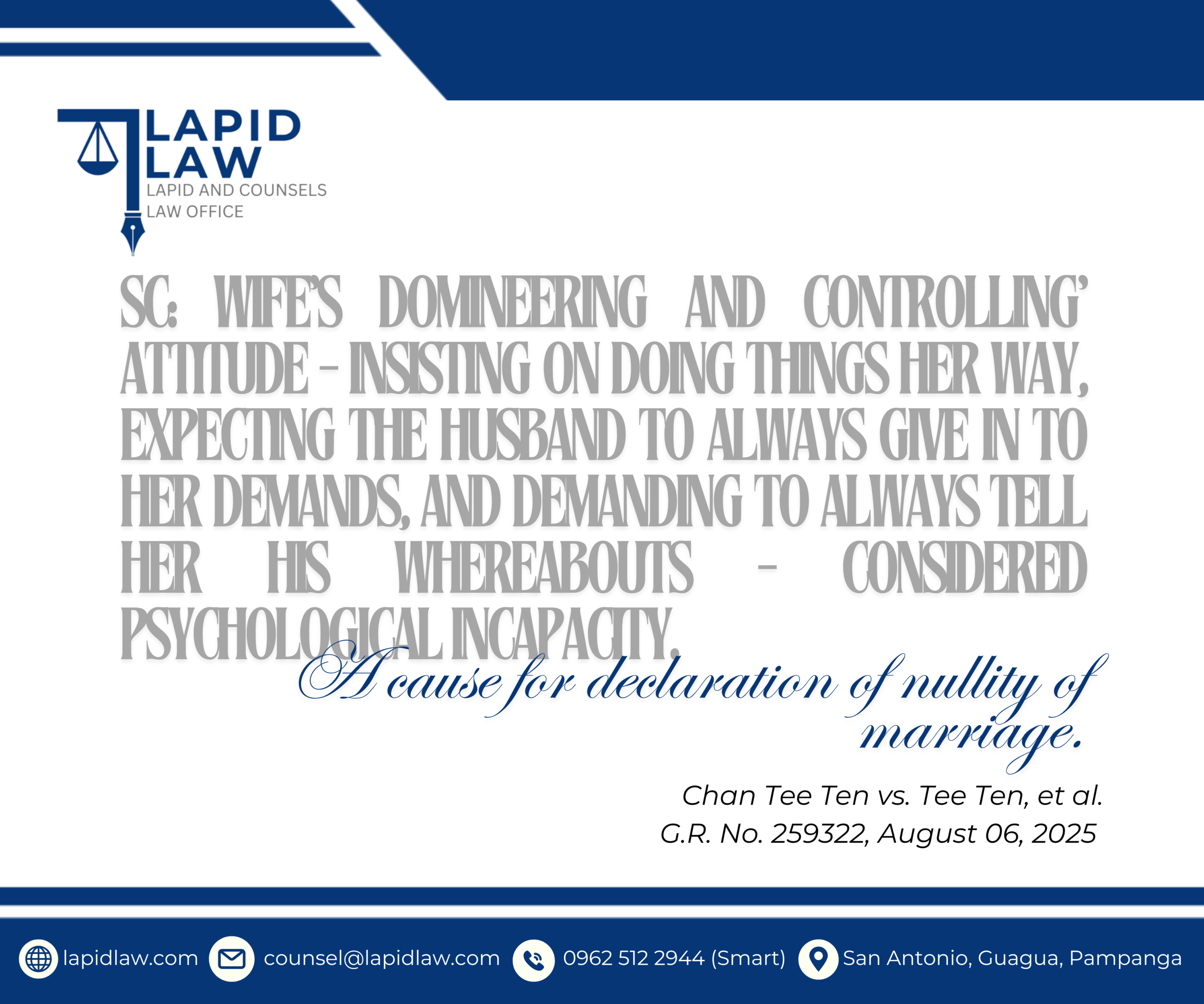
In Chan Tee Ten vs. Tee Ten, et al. (G.R. No. 259322, August 6, 2025), the Supreme Court affirmed the nullification of the marriage between Willy and Nellie, citing the latter’s psychological incapacity under Article 36 of the Family Code.
The case stemmed from Willy’s account of troubling behavior that, according to him, was already evident even before their wedding. He claimed that Nellie, raised in an environment of overindulgence during her family’s affluent years, exhibited a domineering personality and poor sense of responsibility early on. These traits, he argued, only intensified after marriage.
According to court records, Nellie allegedly exercised strict control over Willy, demanding constant updates on his whereabouts and insisting that things be done strictly her way. She was also described as arrogant and haughty, particularly toward Willy’s mother, whom she openly resented. Matters worsened when she accused Willy of having an incestuous relationship with his own mother—an allegation that both the trial court and appellate court found to be a disturbing manifestation of paranoia.
Willy further alleged that Nellie became verbally and physically abusive, not only toward him but also in the presence of their children. He eventually began sleeping in his office to avoid confrontations at home. Despite efforts to reconcile—including moving with the family to a condominium in Pioneer Highlands—the marriage continued to deteriorate.
The situation, as found by the courts, extended beyond spousal conflict. Nellie was accused of manipulating their children against their father and his family, restricting their contact with relatives, and deliberately fostering hostility toward their paternal grandmother. A court social worker testified to behavioral changes in the children that suggested emotional manipulation.
A psychological assessment conducted by clinical psychologist Dr. Natividad A. Dayan concluded that Nellie suffered from Narcissistic Personality Disorder with paranoid features. The report described her as having a grandiose sense of self, an excessive sense of entitlement, and a persistent need to dominate and control her husband. Although Nellie refused to undergo personal evaluation, the courts ruled that the assessment remained credible, as it was based on collateral information and corroborated by multiple witnesses. Thus:
As Dr. Dayan noted, Nellie’s narcissistic personality was clearly manifested by the following:
|
(1) |
She had a grandiose sense of self. She continued to be domineering and controlling. She always insisted on doing things her way and expected Willy to give in to her demands. She also demanded Willy to always tell her his whereabouts; |
|
|
|
|
(2) |
She had an arrogant and haughty attitude, especially toward (sic) Willy’s mother, whom she resented. She had a strained relationship with her mother-in-law; and |
|
|
|
|
(3) |
She displayed an excessive sense of entitlement. She expected to be treated [well] at all times and would readily complain if things were not to her liking. |
In her defense, Nellie denied the accusations and countered that it was Willy who had abused her and their children. She also questioned the validity of the psychological report, arguing that it was biased and incomplete. However, both the Regional Trial Court and the Court of Appeals found her claims insufficient to overturn the evidence of her own psychological incapacity.
The Supreme Court upheld these findings, emphasizing that psychological incapacity does not require medical diagnosis alone but may be established through clear and convincing evidence of a spouse’s inability to perform essential marital obligations. It ruled that Nellie’s controlling, manipulative, and abusive behavior—rooted in her personality structure and present even before the marriage—met this standard.
While affirming the declaration of nullity, the Court remanded the case to the trial court to determine issues relating to support and the settlement of the couple’s co-owned properties.
With the ruling, the marriage was formally declared void, marking the end of a long legal battle shaped by accusations of control, manipulation, and emotional harm within the family.
Legal Disclaimer:
The content on this website is for general informational purposes only and does not constitute legal advice. Lapid and Counsels Law Office (Lapid Law) makes no representations or warranties regarding the accuracy or completeness of the information provided. Accessing this site does not create an attorney-client relationship. For legal advice specific to your situation, please contact a qualified attorney directly. Do not send confidential information via email or this website until a formal attorney-client relationship has been established.
© Copyright. Lapid and Counsels Law Office 2025. All Rights Reserved.